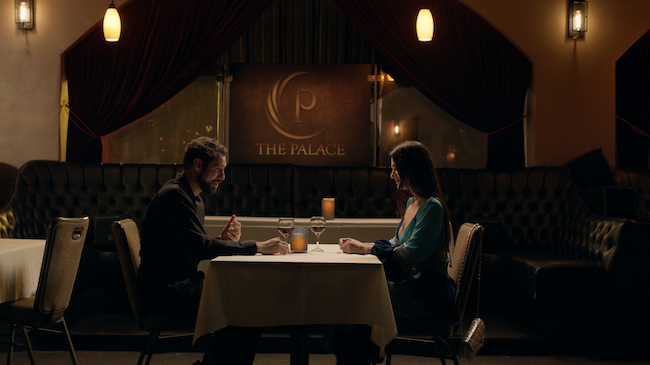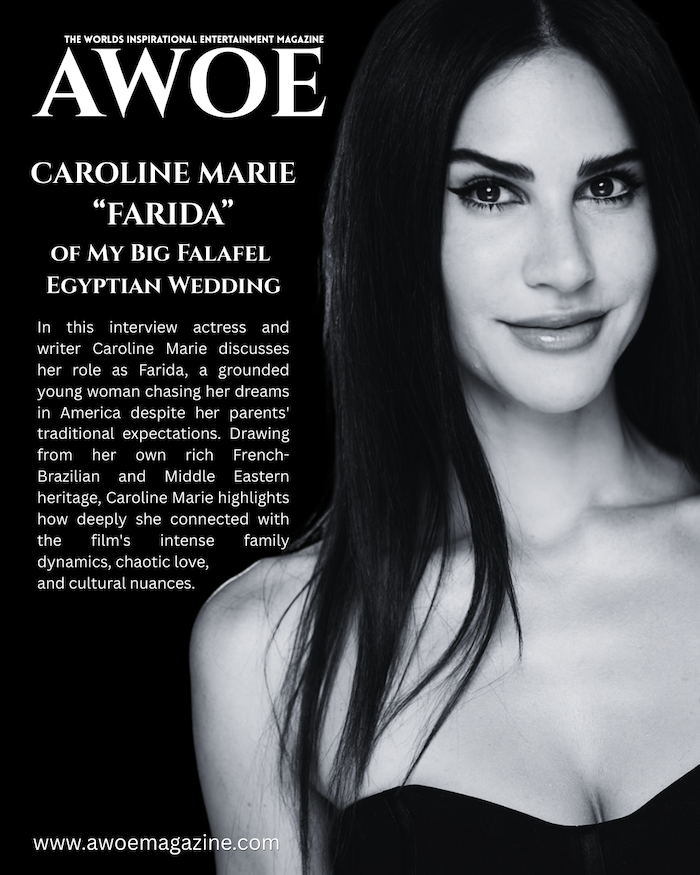
What happens when your lifelong dream collides with generation-old cultural expectations? For Caroline Marie, starring as Farida in the upcoming romantic comedy My Big Falafel Egyptian Wedding, the answer is a hilarious yet deeply human journey of resistance, family bonds, and self-discovery.
In this exclusive interview, the French-Brazilian actress opens up about finding her own family’s Middle Eastern roots in the script, the universal pressure of parental expectations, and why portraying a grounded, honest woman on screen is a breath of fresh air.
THE INTERVIEW
Jen Gault: What drew you to Farida’s character when you read the script for My Big Falafel Egyptian Wedding?
Caroline Marie: I love comedy, as that’s my sweet spot, dramatic comedy especially. I saw Farida as a very grounded character. She has a dream, and she comes from a culture where she wasn’t necessarily expected to have that dream, but she’s going for it anyway. I relate to that. I crossed the world to follow my dream, and it can be very lonely, but it’s always worth it to be who you are. So, I love her. She loves her family, but she also understands they’re a bit crazy.
I think she’s a real character. Sometimes women are written in a way where you go, “That’s not real.” I mean, it’s partially real, but it doesn’t feel like a whole human being. Farida does.
Jen Gault: With your own beautiful and diverse background, did you find it easy to connect with Farida and her experiences?
Caroline Marie: Yes. I come from a French-Brazilian background. My father was born in France and my mother in Brazil, but she herself is half Lebanese and half Syrian. Brazil is known for that kind of mix, and we all just call ourselves Brazilian. So, the Middle Eastern side definitely connected me to Farida. I know the dynamics, the drama, the arguments, and the cousins. Everyone has an opinion about everyone else’s life, and you’re expected to listen. It’s a lot of love, but it’s also very intense, and I think it’s quite different from American culture.
The film is a really good depiction of that. I could totally see my own family in it, in some ways. Obviously it’s a comedy, but I also like that Farida is smart yet gracious. Like every good comedy, the real drama underneath is that she has a dream and can see the vision, but maybe the people around her can’t.
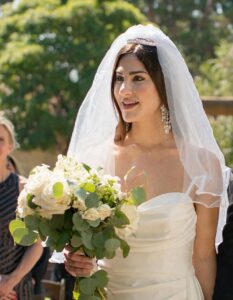 “Me being an actress and a writer was not really what my family expected… so it takes courage, and you will face resistance from your loved ones.”
Parents have expectations of you. Me being an actress and a writer was not really what my family expected; they wanted me to be a lawyer or a diplomat. So it takes courage, and you will face resistance from your loved ones. That’s dramatic, even if it plays as comedy. That’s the underlying theme for Farida.
Jen Gault: What was your favorite aspect of portraying Farida, and did anything about her personality surprise you as you developed the character?
Caroline Marie: I love that Farida doesn’t have any malice. She’s not manipulating anyone. She’s literally doing her best to fulfill the vision she has of herself now that she’s in America, which is different from her parents’ vision. She knows she can be whoever she wants to be.
I don’t want to give away any spoilers, so I can’t say much about the plot, but that was the surprise for me as I developed her: she never manipulates anyone or walks over anyone. She’s a good person. She has her flaws, for sure, but she’s good, and that’s refreshing.
Jen Gault: Farida struggles to balance family expectations with her own desires. Do you believe this is something audiences from various backgrounds can relate to?
Caroline Marie: I think everyone can identify with that, because it’s universal. On one side, your parents want the very best for you. In this culture, until not very long ago, marriage was considered a contract, like creating a company. In a way it really is, as you’re going to work together through problems. The family would assess the other person’s family, their background, and how they were raised. That has a lot of value, but in this new culture, it doesn’t have a place. So, that’s one side people can relate to.
On the other hand, many parents project onto their kids what they couldn’t do in their own lives, and I think that’s the wider context. It’s a form of control and projection. That’s where anyone can identify and say, “You’re not seeing me for who I am. I’m standing right in front of you, and I know you love me.”
“There’s that feeling when we follow a dream against our loved ones’ wishes… for some reason we can’t sleep at night if we don’t do it. It keeps calling us.”
Then there’s that feeling when we follow a dream against our loved ones’ wishes, when we just know it’s in our heart, and for some reason we can’t sleep at night if we don’t do it. It keeps calling us. That’s something else people can relate to. One thing is being a pure rebel, or being lost in life where your family can see you don’t know what you’re doing. The other thing is saying, “I know what I’m doing. I love you too, but I’m still going to do what I want to do.”
Jen Gault: What insights did playing Farida provide you about the complex relationship between a daughter and her father?
Caroline Marie: That’s funny, because I told Steve, who plays my father, “You look like my father.” He couldn’t see the resemblance, but I saw it.
I remember the first time I brought a serious boyfriend to meet my father. My parents were divorced, so my mother had already met him, and now I was introducing him to my father. My father said to my boyfriend, “I knew her before you, and I’ve loved her longer.” To this day, I have no idea what he meant by that! We were 20 years old. It was a bit insane. I think fathers sometimes want to protect you, but their behavior can be a bit irrational. That’s how I’d explain it: if they have complete control over a situation, they think they can protect you.
Jen Gault: While portraying an Egyptian daughter, what aspects of Egyptian culture and family traditions touched your heart?
Caroline Marie: I keep coming back to the fact that I’m Brazilian. In Brazil, we have more Lebanese people than in Lebanon, which is over 7 million, and a lot of Syrians, too. It goes back to the 1900s during the wars when people would just cross over to Brazil. So, Brazilian culture, especially in my state of São Paulo, is mainly Lebanese and Italian. It’s like New York with a lot of Italians.
“In Middle Eastern culture, the love language is, ‘I feed you.’ And if you don’t eat, you hate me and you’ve dishonored me!”
For me, it was interesting to see how close it all is. I felt like, “These are my people. I recognize this.” I recognize the warmth. In Middle Eastern culture, the love language is, “I feed you.” And if you don’t eat, you hate me and you’ve dishonored me! But there’s a lot of joy. The culture lives life with intensity. The closest thing I can compare it to is the Italians. There you go, Mamma Mia, for no reason at all.
Want to hear the other side of the family drama? Read the
Exclusive Interview with Steve Shermett to find out what it’s really like playing Farida’s protective, traditional, and protective father, Zoser, in
My Big Falafel Egyptian Wedding.
Curious about how this chaotic cross-cultural world was built from behind the camera? Dive into our
Exclusive Interview with Director Peter Takla to learn how he blended independent filmmaking, Egyptian-American traditions, and laugh-out-loud comedy into a singular vision.