
ENTERTAINMENT
Young Washington
MOVIE REVIEW
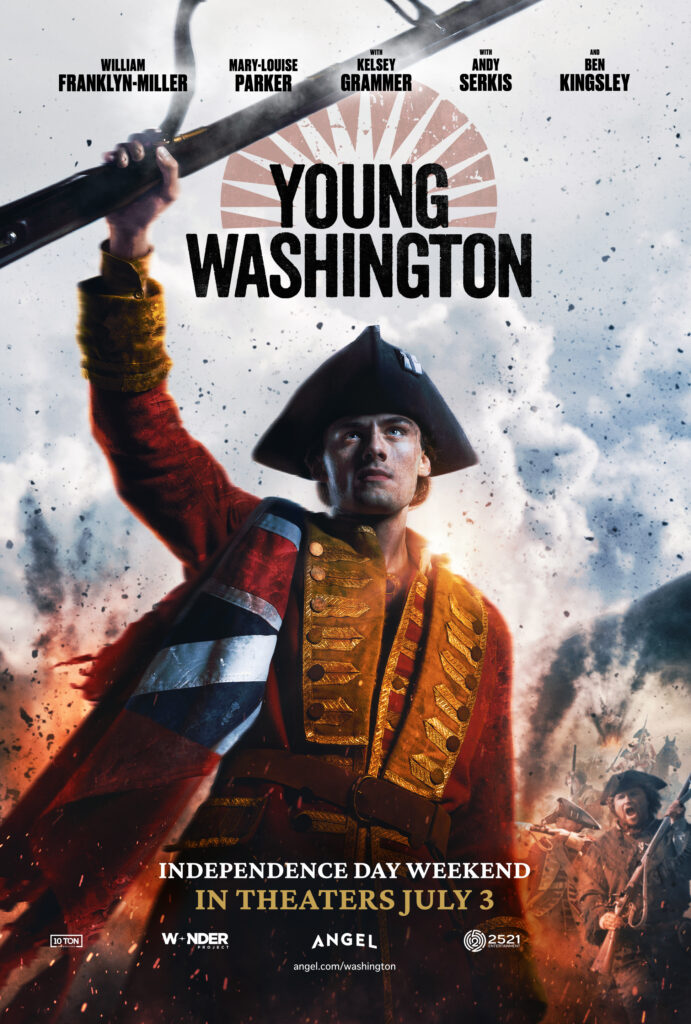
The Man Before the Legend
Young Washington was brilliant. I genuinely enjoyed this movie.
William Franklyn Miller, who plays the young George Washington, was terrific. He was handsome, kind, ambitious, and most importantly, believable. What I appreciated most was that the film did not begin with the larger than life George Washington we all know from our history books. Instead, we meet a young man who is still trying to figure out who he is, where he belongs, and how he is going to make something of himself.
That made him feel human.
The family relationships were some of my favorite parts of the movie. Mary Louise Parker, as Washington’s mother, Mary Ball Washington, was especially powerful. She brought strength, honesty, and character to the role, and I loved the way she showed a mother who could be both tough on her son and deeply concerned about his future. There were moments when her doubts about George seemed to give way to something closer to belief, and those moments carried a lot of emotion.
John Foss, who plays George’s older half brother, Lawrence Washington, also brought a lot of heart to the story. Lawrence was enormously important in George’s early life. He was married to Anne Fairfax, which connected the Washington family to the influential Fairfax family and gave young George an opportunity to enter a world of wealth, education, manners, and social standing that was otherwise difficult for him to reach.
And then there is Sally.
Mia Rodgers plays Sally Cary, the young woman who catches Washington’s attention, and I thought the chemistry between the two was wonderful. I found myself getting invested in their relationship even though I already knew it was not going to have the ending we might hope for.
What made that storyline even more interesting to me was finding out how much of the emotional foundation actually came from real life. Sally Cary was a real neighbor and friend of Washington’s. She later became Sally Fairfax after marrying George William Fairfax. Washington knew her for years, and their surviving correspondence shows that there were strong feelings between them. The movie certainly heightens the romance, but it did not simply invent the connection. The filmmakers drew from letters exchanged over many years, which gives their relationship a fascinating historical foundation.
Of course, history did not give them their happily ever after. That makes their scenes together even more bittersweet.
I also loved Kelsey Grammer as Lord Thomas Fairfax. And yes, it is always fun to see Frasier playing an aristocrat, but Grammer really worked in this role. Fairfax is portrayed as a man who recognizes something in this ambitious young Virginian and gives him an opportunity to prove himself.
That opportunity matters because surveying was a real and important part of Washington’s early life. His connection to the Fairfax family helped open the door to his surveying career, and those experiences took him into the frontier and into the complicated struggle between British, French, and Native interests in the Ohio country.
Joel Smallbone plays William Fairfax, Lord Fairfax’s son, and he adds another interesting dimension to Washington’s world. I thought Smallbone brought a warmth and tension to those scenes that helped show just how much George was trying to find his place among people who were born into privilege.
Then we have Andy Serkis as General Edward Braddock. He was very well done. Braddock represents the professional British military establishment that Washington desperately wants to be part of. Serkis gives him confidence and authority, but also the stubbornness of a man who believes his military experience should be enough to carry him through unfamiliar territory.
Sir Ben Kingsley, as Robert Dinwiddie, Virginia’s lieutenant governor, was another excellent choice. Kingsley brings weight to the role, and Dinwiddie was an important figure in Washington’s early military career. These relationships help explain how a young Virginia surveyor began moving toward the military life that would eventually define him.
But for me, one of the most fascinating parts of Young Washington is the spiritual element surrounding his survival.
During the Battle of the Monongahela in 1755, Washington seemed almost impossible to kill. He later wrote to his brother John Augustine Washington that four bullets had gone through his coat and that two horses had been shot from underneath him, yet he escaped without a wound. Washington himself did not simply describe this as extraordinary luck. He wrote that he had been protected by the “dispensations of Providence.” For a young man who would later become such an important figure in American history, that is a remarkable thing to read in his own words.
And then there is the story that became known as the “Indian Prophecy.”
According to a later account, a Native sachem who had fought against Washington at the Battle of the Monongahela told him that he had ordered his warriors to kill him. Yet their shots somehow missed. The story says the sachem concluded that a power greater than they had protected Washington and predicted that he would one day become the leader of a great nation.
It is an extraordinary story.
But this is where I think it is important to separate history from legend. The prophecy was not recorded at the time of the battle. The fullest version appeared decades later through Washington’s friend and physician, Dr. James Craik, and was published by Washington’s step grandson, George Washington Parke Custis, in the 1820s. Historians generally regard the story as a legend that may have grown out of a real and remarkable event.
What we do know is that Washington really did survive an astonishing amount of gunfire at Monongahela, and Washington himself believed Providence had protected him.
We also know the names of some of the Native leaders who were genuinely part of Washington’s early story. One was Tanacharison, often called the Half King, who accompanied Washington on his 1753 journey to the French. Another was Guyasuta, also known as Kiashuta or the Hunter, a Seneca leader whom Washington encountered during that earlier journey and met again in 1770. Interestingly, Washington’s own journal records meeting Guyasuta again, but Washington did not record the famous prophecy. There is also no solid contemporary evidence that Guyasuta was the Native leader responsible for the story.
That distinction actually makes the story more interesting to me rather than less.
Whether we view the prophecy as history, legend, or some combination of the two, the spiritual thread is real. Washington survived a battle that killed and wounded men all around him, and he believed that Providence had spared his life for a reason. Knowing what he would eventually become makes that moment feel almost haunting.
And then, of course, there is the war.
This is where Young Washington becomes much more than a period romance or family drama. We see Washington thrown into the French and Indian War before he is the polished military commander we know from the American Revolution. He makes mistakes. He gets humbled. He learns.
That is one of the things I appreciated most about the movie.
Washington’s early military career was not a story of instant greatness. The Battle of Fort Necessity in 1754 was a serious defeat, and the Battle of the Monongahela the following year was another disaster for the British. General Braddock was mortally wounded, and the British forces were badly defeated. Washington came away from those experiences with lessons that would stay with him for the rest of his life.
The movie does take liberties with the timeline and with some of the individual events. Some characters and relationships are compressed or rearranged for dramatic purposes, and the Sally Cary storyline is more romanticized than the surviving historical record can prove. The film is telling a story, not creating a documentary.
And honestly, I did not mind the historical liberties nearly as much as I expected to.
For me, Young Washington had all the right ingredients. It had family, romance, adventure, war, beautiful costumes, social class, manners, and the rules of etiquette that shaped eighteenth century society. I especially enjoyed watching Washington learn how to conduct himself as a gentleman and understand the world he was trying so hard to enter.
There is something fascinating about watching him learn that becoming a leader is not only about courage on a battlefield. It is also about discipline, character, confidence, humility, and learning how to carry yourself in a world where birth and social standing could determine how far you were allowed to go.
And surprisingly, I found the movie to be quite family friendly. There is violence because this is a story about war, but the heart of the film is really about character. It is about ambition, loyalty, courage, family, failure, perseverance, and the process of becoming the person you were meant to be.
That is probably what I enjoyed most.
We all know the George Washington who became the commander of the Continental Army and the first president of the United States. We know the portrait, the monument, the dollar bill, and the legend.
But Young Washington asks us to look at the man before all of that.
The young George Washington was not yet a legend. He was ambitious. He was sometimes uncertain. He made mistakes. He fell in love. He wanted to be accepted. He wanted to prove himself. He was learning how to become a gentleman, a soldier, and eventually a leader.
Was every moment historically accurate?
Absolutely not.
But was it fun?
Absolutely.
I thought Young Washington was beautifully put together and genuinely entertaining. The performances pulled me into the story, the relationships gave it heart, and the spiritual element added a layer that I found surprisingly moving.
Maybe that is why I enjoyed it so much. It did not ask me to look at George Washington as a perfect man who arrived fully formed in history.
It let me watch him become George Washington.
And for me, that made all the difference